
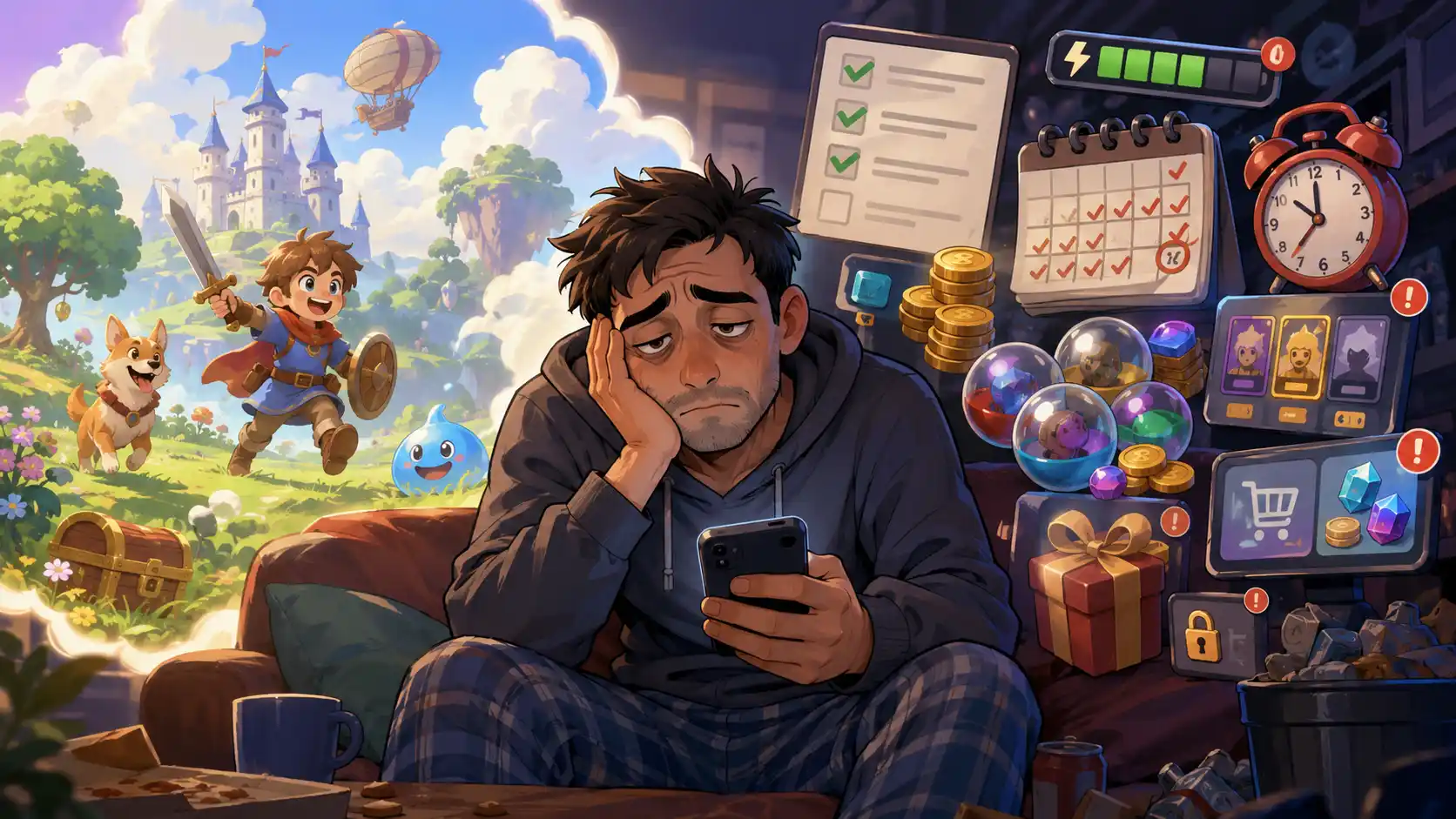
I used to think I had simply grown out of mobile games. Then I looked back and realized something strange.
I didn’t leave because I hated them. Well, maybe a little, to be honest. But mostly, I left because they quietly changed the relationship between the player and the game.
And the funny part? I’m probably one of the last people who should be saying this.
I’ve Never Been Loyal to One Platform
I started on the SNES before moving to the original PlayStation. Later, I became a PC gamer, but I never really abandoned mobile gaming either. I played Java and Symbian games, even bought a Nokia N-Gage—yes, I was one of those people—and later worked at a PC gaming magazine and a third-party app store, where mobile games became part of my daily job.
I also played handheld systems such as the PSP and Nintendo Switch.
The point is, I’ve never been loyal to a single platform. I’ve loved console games. I’ve loved PC games. And for a long time, I genuinely liked mobile games too.
Maybe check this out, too: PC vs Smartphone: The Business of Obsolescence?
Somewhere Along the Way, Playing Became Managing
Looking back, I don’t think the problem was ever the gameplay. Many mobile games are genuinely fun.
The problem was everything surrounding the gameplay:
- Daily quests
- Limited-time events
- Battle passes
- Login rewards
- Energy systems
- Twenty-three different currencies whose names sound as though they were generated by rolling dice
Instead of asking: “Do you want to play today?” The game slowly started asking: “Have you completed today’s checklist?” That is a subtle difference, but an important one. One invites you to play. The other reminds you that you are behind schedule.
The Business of Running Out of Fun
One mechanic I’ve grown to dislike over the years is artificial scarcity. You have probably seen it. You are having fun, progressing through the game, and then suddenly it tells you to wait four hours.
Or six.
Or buy more stamina.
It is a clever business model, but from a player’s perspective, it creates a strange feeling. Older games usually stopped you because they became difficult. Modern mobile games often stop you because a timer says so.
One challenges your skill. The other tests your patience. Guess which one has a “Skip for $4.99” button.
The Most Expensive Games I No Longer Own
Here is another realization that still surprises me: Over the years, I have probably spent more than $5,500 across various mobile games.
Yes. I know. I don’t want to do the math either.
What is even stranger is that some of those games no longer exist. Servers closed. Communities disappeared. Years of purchases simply vanished.
Sure, I don’t have my old PlayStation games anymore either. I had to sell the console after my phone somehow disappeared from my pocket, forcing the PlayStation to reincarnate as a Nokia phone with polyphonic ringtones.
A tragic transformation. From Final Fantasy to “Crazy Frog,” or whatever counted as luxury audio at the time.
But had I kept the console and the discs, I might still be able to play Suikoden II, The Legend of Dragoon, or my other favorite games from that magical period of life when I was apparently happy all the time, unlike now.
The AAA and indie games I bought on Steam are still there too, waiting like long-lost friends who never forget you. I can simply press Download and spend hundreds of hours in Cyberpunk 2077, Pillars of Eternity II: Deadfire, or even an adult visual novel whose title should probably remain classified.
With live-service games, however, your purchases often exist only for as long as the servers—and the business model—allow them to.
Might or might not be related: The Psychology of Gacha: Why Humans Love Paying for Random Rewards
The Difference Between Finishing and Quitting
I think this is what I miss most: Endings.
When I finish a great single-player game, there is a sense of closure. The credits roll. The story ends. I sit there for a few minutes thinking:
“That was worth it.”
Sometimes I uninstall the game immediately afterward—not because I am tired of it, but because it is complete. That is a beautiful feeling.
Most mobile games do not end that way. They end when another banner arrives, another progression system appears, another daily routine begins, or when you finally realize that you are logging in out of habit rather than excitement.
You do not finish them. You quit them. And those two emotions could not be more different.
Games or Engagement Machines?
I do not blame developers. Making games is expensive. Running online servers is expensive. Players expect years of updates, new characters, new events, new maps, and regular compensation whenever a server goes down for eleven minutes.
Someone has to pay for all of that.
The problem is not that companies want to make money. The problem is that many games have quietly changed what they are optimizing for.
Instead of asking: “How do we make players love this game?” The question increasingly becomes: “How do we make them come back tomorrow?”
Those questions sound similar. They are not. A memorable game wants your attention because you are curious about what happens next. An engagement-driven game often wants your attention because you are afraid of missing out.
| Memorable games | Engagement-driven games |
|---|---|
| Create curiosity | Create urgency |
| Respect your stopping point | Punish your absence |
| Build memories | Build habits |
| Let the journey end | Need the journey to continue forever |
One creates memories. The other creates habits.
I Didn’t Stop Playing Mobile Games
I just stopped enjoying games that felt like obligations. Ironically, some of my favorite mobile games were the simplest ones:
- Open the game.
- Play for twenty minutes.
- Have fun.
- Close it.
No guilt. No timer. No pressure. Maybe that is what I miss most.
Games used to ask for my imagination. Some now ask for my calendar. And over the years, I have realized something: The best games I have ever played ended because they had something meaningful to say.
The ones I quietly walked away from usually ended because they had something else to sell.
