
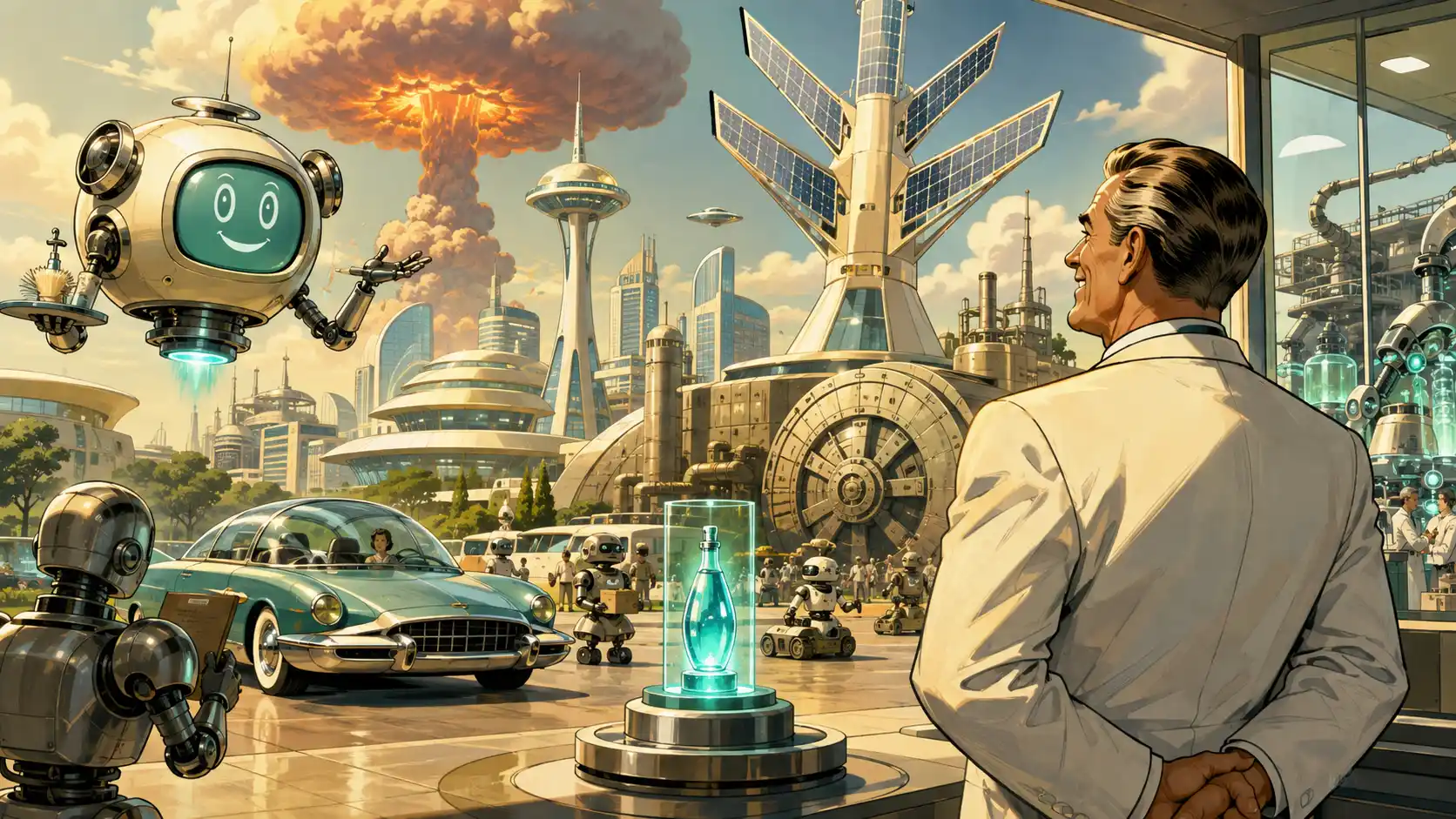
Fallout’s America had a government. Technically.
But by 2077, enormous corporations were building military robots, developing biological weapons, running nuclear shelters, shaping the news, experimenting on civilians, and occasionally helping the government invent exciting new methods of destroying civilisation.
This was apparently considered normal business activity.
The corporations of Fallout are more than background scenery or convenient names printed on abandoned factories. They explain how pre-war America actually worked.
Private companies became deeply intertwined with the military, government, and everyday life. Consumer brands turned into defence contractors. Technology companies built weapons. Media companies distributed propaganda. Research firms treated ethics as an optional software package.
Then the bombs fell. The companies disappeared. Their products did not.
Vault-Tec: Monetising the Apocalypse
We already covered Vault-Tec extensively, so the short version is simple: Vault-Tec sold survival.
Publicly, it constructed underground shelters designed to protect Americans from nuclear war. Secretly, most Vaults were used for social, medical, psychological, and technological experiments.
By the final years before the Great War, Vault-Tec had become deeply connected to the US government, military-industrial establishment, and the organisation that would become the Enclave.
It even invited other powerful corporations to participate in the Vault programme, allowing executives to imagine their own experiments and potential monopolies in the post-war world.
Vault-Tec therefore represents perhaps the purest version of Fallout capitalism: Identify an existential crisis. Create a product that supposedly solves it. Then secretly make the product significantly worse.
RobCo Industries: Big Tech, but With Sentry Bots
If Vault-Tec dominated survival, RobCo Industries dominated technology.
Robert House founded RobCo in 2042, and within decades the company had become one of America’s most powerful technology corporations.
Its operating system became an industry standard across the 13 Commonwealths. RobCo software appeared throughout civilian infrastructure, government systems, and military installations. Its hardware was equally widespread.
RobCo produced machines such as:
- Protectrons
- Sentry Bots
- Eyebots
- Pip-Boy systems
- Automated security platforms
It also acquired REPCONN Aerospace and worked closely with both Vault-Tec and General Atomics. RobCo even reverse-engineered Chinese stealth technology to develop the Stealth Boy.
And if that was insufficiently ambitious, RobCo partnered with General Atomics on Liberty Prime, an enormous combat robot designed to fight communist forces in Alaska. The project essentially answered an important engineering question:
What if anti-communist propaganda were 40 feet tall and had nuclear weapons?
RobCo is Fallout’s version of a company becoming so embedded in society that distinguishing technology infrastructure from corporate infrastructure becomes almost impossible.
The world ended. RobCo’s operating system still booted. That is either excellent engineering or the most terrifying customer-retention strategy ever developed.
General Atomics: Your Robot Butler Is Also a Weapons Platform
General Atomics International was RobCo’s major competitor in robotics. Its most famous creation was the Mr. Handy, introduced in 2037 as a multipurpose robot for construction and household work.
Mr. Handy became enormously popular. Its descendants cooked meals, cleaned houses, maintained facilities, operated businesses, and somehow remained functional centuries after their warranties presumably expired. General Atomics eventually expanded into more advanced robotics, energy systems, nuclear reactors, and weapons.
One of its stranger projects was the Robobrain. The concept was straightforward:
- Take a human brain.
- Put it inside a robot.
- Add weapons.
Corporate R&D meetings were clearly different in 2077.
General Atomics also experimented with autonomous facilities that could continue operating without humans and partnered with RobCo on advanced robotic projects.
This matters because Fallout repeatedly shows automation replacing enormous parts of human labour before the Great War. Factories became automated. Security became automated. Military systems became automated. Even customer service became automated. Human civilisation eventually disappeared.
The customer-service robots continued asking whether they could be of assistance.
West Tek: From Medicine to Super Mutants
Of all Fallout corporations, West Tek may have produced the most spectacular example of research scope creep.
The company operated advanced weapons and biomedical research divisions. It developed military technologies, participated in power-armour research, and contributed to technologies that eventually produced the T-51.
Its biomedical work initially had a perfectly reasonable objective.
During the New Plague, West Tek researched ways to protect humans from disease. Later, the US government asked it to develop broad protection against biological warfare.
This eventually produced the Pan-Immunity Virion Project. Researchers discovered that the virus could dramatically alter human cells, increasing muscle mass and changing genetic structures. The military became interested.
The programme evolved into the Forced Evolutionary Virus, or FEV. If you have played Fallout, you probably know how well that went. FEV ultimately helped create super mutants, mutated creatures, horrifying experiments, and several hundred years of wasteland problems.
West Tek began by trying to prevent disease. It ended by helping invent green giants with machine guns. That is why product roadmaps need boundaries.
Nuka-Cola: Somehow the Soft Drink Became Radioactive Too
Nuka-Cola was already one of America’s largest consumer brands long before the war.
By the 2060s, its vending machines were everywhere, its merchandise had become part of popular culture, and the company had expanded into entertainment through Nuka-World.
Then founder John-Caleb Bradberton developed an interest in military research and immortality. This is usually where stories about beverage executives become unusual.
Bradberton cooperated with the US military on weapons research in exchange for access to an experimental life-extension programme. That collaboration eventually produced a weaponised isotope of strontium-90.
Nuka-Cola researchers realised the isotope could also be placed into a beverage. The result was Nuka-Cola Quantum.
Developing a drink containing radioactive material required extensive human testing. According to the transcript, at least 62 test subjects died from organ failure, while others suffered severe radiation injuries.
The company responded with condolence fruit-and-cheese baskets and legal waivers. This might be the most Fallout corporate response imaginable.
Nuka-Cola nevertheless remained so culturally dominant that its bottle caps eventually became currency across parts of the wasteland. The company collapsed. Its packaging accidentally became a monetary system. Marketing departments dream of brand loyalty like this.
Chryslus Motors: Nuclear Power in the Family Car
Fallout’s retro-futuristic cars largely came from companies such as Chryslus Motors. Chryslus helped bring fusion-powered automobiles into the consumer market, most famously through the Corvega line.
Its vehicles combined advanced atomic technology with enormous mid-century American styling. They were beautiful. They were expensive. They also contained nuclear components.
Nothing completes the suburban lifestyle quite like parking a miniature reactor beside the children’s bedroom.
Chryslus launched its first fusion-powered vehicle around 2070, and demand quickly exceeded supply. Production was complicated by the war economy, as civilian factories were increasingly redirected toward military needs.
After the Great War, Chryslus vehicles remained scattered across America. They generally stopped functioning. Their reactors, however, could still explode. A proud legacy of American manufacturing.
Galaxy News Network: Manufacturing Reality
Corporations did not only build machines. They helped shape what Americans believed.
Galaxy News Network, or GNN, was one of the country’s most influential media organisations before the Great War. Its broadcasts strongly supported the US government and routinely framed events through patriotic narratives.
When American power-armoured soldiers executed a Canadian prisoner during the annexation of Canada, GNN presented the occupation as peacekeeping. Environmental disasters were similarly softened or reframed.
GNN also maintained a close relationship with Vault-Tec and received privileged access to Vault facilities. The important point is not simply that GNN broadcast propaganda. It demonstrates how tightly connected corporate media, government policy, and major private companies had become.
America was deteriorating. The broadcasts remained reassuring. The tanks were peacekeepers. The shortages were temporary. Victory was approaching. Everything was fine. Please remain tuned for advertisements.
HalluciGen: “Non-Lethal” Needs Quotation Marks
HalluciGen specialised in biochemical weapons intended for military and police crowd control. Its flagship products were marketed as non-lethal. This description became increasingly theoretical.
Experiments frequently produced severe injuries or deaths, and HalluciGen used human test subjects while deliberately making consent paperwork difficult to understand.
During emergencies, executives received evacuation priority. Test subjects did not.
By 2077, the company was also experiencing enormous financial losses, yet continued pursuing military contracts and experimental projects. Vault-Tec even hired HalluciGen to develop psychoactive chemicals capable of altering Vault residents’ moods.
The company represents another recurring feature of Fallout’s corporate world: If the product fails horribly, simply classify the failure and continue testing. Preferably on somebody else.
Definitely related: Major Fallout Factions Explained: Who Should Rule the Wasteland?
Poseidon Energy: Power Company, Defence Contractor, Secret Government Friend
Energy companies became especially important during Fallout’s global resource crisis.
Poseidon Energy grew into one of America’s major energy corporations and maintained close links with the government and military-industrial system. One of its most famous facilities was HELIOS One, a huge solar power plant near Las Vegas.
Publicly, HELIOS One represented renewable energy and the possibility of a cleaner future. Secretly, the facility also supported ARCHIMEDES, an experimental weapons programme. Because apparently nobody in Fallout was allowed to build a power station without eventually asking: “Could this become a laser?”
Poseidon demonstrates the central contradiction of pre-war America. Even technologies capable of solving parts of the resource crisis were repeatedly absorbed into military competition.
The world desperately needed energy. It received weaponised energy.
Fallout’s Corporations Did Not Cause the Apocalypse Alone
It would be too simple to say corporations destroyed Fallout’s world. Governments launched wars. Military leaders built arsenals. Countries fought over resources. Citizens supported systems built on fear and nationalism. But corporations became essential parts of that machinery.
RobCo automated it. West Tek researched it. General Atomics manufactured it. GNN explained why it was necessary. Nuka-Cola sold refreshments during it. Vault-Tec prepared to profit after it.
The unsettling part is that many of these companies were genuinely innovative. Fusion vehicles could reduce dependence on oil. Robotics could eliminate dangerous labour. Medical biotechnology could cure disease. Solar energy could address resource scarcity.
Instead, those technologies became increasingly tied to military contracts, corporate competition, political influence, and secrecy. Fallout’s old world did not lack innovation. It lacked institutions capable of asking whether every profitable innovation should actually exist.
And then, on October 23, 2077, the market finally closed. Permanently. The vending machines are still working, though.
