
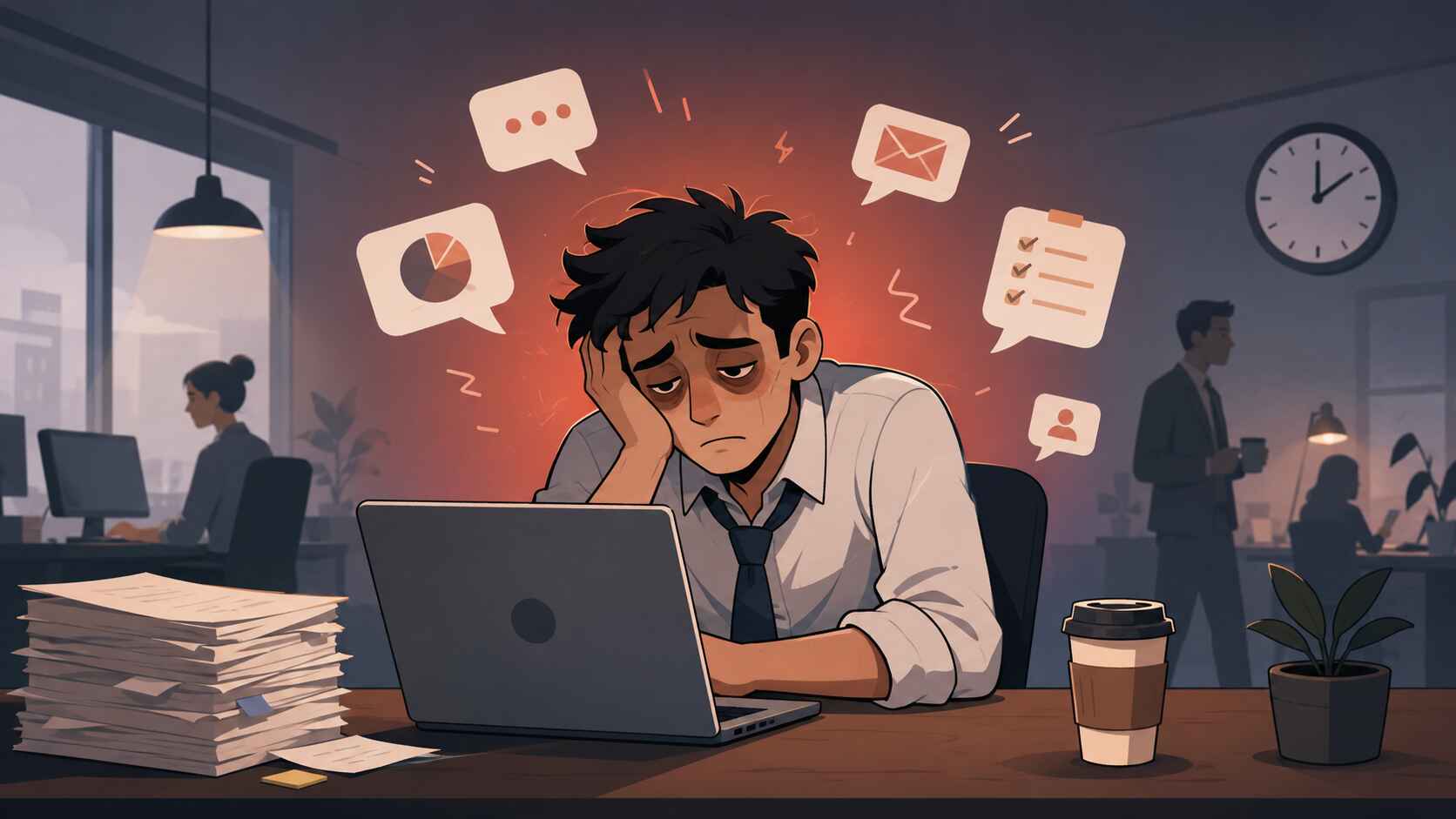
In many workplaces, burnout does not officially exist.
Employees may become exhausted, cynical, forgetful, emotionally numb, and increasingly unable to perform work they once handled well. But the problem is rarely called burnout. It is called a lack of discipline. Poor time management. Low commitment. Or perhaps the most efficient explanation of all: “Everyone is tired.”
That sentence can end almost any conversation about workplace stress. It acknowledges the suffering while also declaring it irrelevant. Yes, the employee is exhausted—but so is everyone else, so please return to the spreadsheet.
This is especially common in cultures where long hours are treated as proof of loyalty, constant availability is mistaken for professionalism, and surviving unreasonable conditions is considered a personality strength. Employees who struggle are not always asked what is happening to them. They are asked why they cannot handle what everyone else supposedly can.
The irony is that burnout often becomes visible only after it begins harming the company.
Productivity falls. Mistakes increase. Employees withdraw, take more sick leave, or resign. Experienced workers stop contributing ideas and start doing only enough to survive the day. Managers then describe the workforce as lazy, unmotivated, or difficult to retain.
The company notices the symptoms. It simply does not recognise the diagnosis. Burnout is therefore not only misunderstood as an employee wellness issue. In many organisations, it is not recognised as an issue at all.
But when exhaustion, cynicism, declining performance, and resignations begin appearing across an entire team, companies should ask a more uncomfortable question:
What if the employees are not failing to survive the workplace? What if the workplace is failing the employees?
Burnout Is More Than Being Very Tired
“Burnout” has become one of those words we use so casually that it can mean almost anything.
Tired after a long meeting? Burnout. Bored with a project? Burnout. Microsoft Teams made that notification sound again? Catastrophic psychological collapse.
Scientifically, burnout has a narrower meaning.
The World Health Organization includes burnout in the International Classification of Diseases, or ICD-11, as an occupational phenomenon. It is not classified as a medical condition. The WHO describes it as a syndrome resulting from chronic workplace stress that has not been successfully managed.
This definition contains two important ideas.
First, burnout develops from chronic stress, not merely one terrible day, one difficult client, or one meeting that should have been an email.
Second, the WHO definition specifically connects burnout to work.
Research led by psychologist Christina Maslach and her colleagues has traditionally described burnout through three central dimensions: exhaustion, cynicism or psychological detachment, and reduced professional efficacy.
Together, they explain why burnout is more complicated than simply needing a long weekend.
Exhaustion
Exhaustion is the most recognisable component.
People feel physically, mentally, or emotionally depleted. Starting ordinary tasks requires unusual effort. Interacting with colleagues becomes draining. Rest may provide temporary relief, but the exhaustion quickly returns when work resumes.
This is not always the satisfying tiredness that follows difficult but meaningful work. It is more like repeatedly charging a damaged battery to 38 percent and being told that should be enough for another quarterly sprint.
Cynicism and Detachment
The second dimension is a growing psychological distance from work.
Employees may become negative, irritable, sarcastic, numb, or indifferent. They may stop caring about customers, projects, colleagues, or outcomes that once mattered to them.
Management often interprets this as a “bad attitude.” But emotional detachment can also function as self-protection.
Caring requires energy. When people repeatedly spend emotional effort without enough recovery, support, control, or reward, caring less may become one of the few ways to conserve what remains.
The employee does not necessarily decide to become unbearable. Sometimes the nervous system simply begins cutting nonessential spending, and enthusiasm is apparently considered a luxury subscription.
Reduced Professional Efficacy
The third dimension is the growing belief that one is no longer capable or effective.
People may begin thinking:
- “I’m becoming bad at this.”
- “Nothing I do makes a difference.”
- “I can’t keep up anymore.”
Performance may genuinely decline. Burnout can involve difficulty concentrating, reduced creativity, forgetfulness, slower decision-making, and more mistakes.
But perception matters too. Someone may continue producing acceptable work while feeling increasingly incompetent because every task now requires far more effort than before.
The dimensions can reinforce one another. Excessive demands create exhaustion. Exhaustion encourages withdrawal. Detachment and impaired performance reduce a person’s sense of accomplishment, which may push them to work even harder to compensate.
Congratulations: the workplace has built a treadmill that accelerates whenever the runner gets tired.
Burnout Is Not Simply the Price of Working Hard
It is tempting to explain burnout using a simple formula:
More work equals more burnout.
Workload certainly matters. A systematic review and meta-analysis published in BMC Public Health found consistent evidence linking high job demands with greater exhaustion. It also identified protective factors such as control, workplace support, reward, and organisational justice.
But workload is not the entire story.
People can sometimes perform extraordinarily demanding work without burning out, particularly when the effort is temporary, meaningful, adequately supported, fairly rewarded, and followed by genuine recovery.
Meanwhile, someone can burn out in a job that does not look especially intense from the outside. The difference often lies in the relationship between job demands and job resources.
The Job Demands–Resources model, developed by organisational psychologists including Arnold Bakker and Evangelia Demerouti, proposes that every occupation contains demands that consume energy and resources that help people perform, remain motivated, and recover.
Also read: Gen Z Work Ethic: Why Young Workers Are Rejecting Corporate Culture
Job demands may include:
- heavy workloads and time pressure;
- difficult customers or emotional interactions;
- job insecurity;
- unclear responsibilities;
- interpersonal conflict;
- long or unpredictable hours.
Job resources may include:
- autonomy;
- supportive managers and colleagues;
- adequate staffing;
- fair compensation;
- useful feedback;
- recognition;
High demands are not automatically destructive. Problems emerge when demands remain persistently high while resources remain painfully low.
Hard work can be sustainable when people have the tools, authority, support, and recovery time required to do it. It becomes dangerous when a company continually increases expectations while removing everything that makes those expectations survivable.
The Six Workplace Mismatches Behind Burnout
Maslach and Michael Leiter have described six major areas where a mismatch between workers and their jobs can contribute to burnout: workload, control, reward, community, fairness, and values.
These mismatches help explain why burnout cannot always be solved by telling employees to manage stress more effectively.
Workload
The most obvious mismatch occurs when demands exceed what people can realistically complete.
This is not just about having many tasks. Workload becomes damaging when staffing is inadequate, priorities constantly change, deadlines remain unrealistic, and temporary responsibilities quietly become permanent.
One short crisis produces fatigue. A crisis that lasts three years is simply the organisational structure.
Control
People are more vulnerable when they are responsible for outcomes but have little influence over how those outcomes are produced. They may have no control over schedules, methods, priorities, resources, or deadlines. Managers might micromanage minor decisions while disappearing whenever actual responsibility arrives.
Research has repeatedly found that greater control can protect against exhaustion, while low control increases risk.
Autonomy does not mean employees can do whatever they like. It means they possess enough authority to apply judgement and organise their work intelligently. Without control, employees become passengers who will later be blamed for where the bus crashes.
Reward
Reward includes salary, but also recognition, respect, security, development opportunities, and evidence that effort matters. One reliable way to destroy motivation is to reward competent employees exclusively with more work.
They solve problems quickly, so they receive additional problems. They remain calm during crises, so management concludes they require neither support nor appreciation.
Eventually, the organisation teaches them an important lesson: Competence is punishable.
Community
Demanding work becomes more manageable when people trust and support one another.
A healthy professional community does not require colleagues to become a manufactured corporate family. Employees do not need trust falls or mandatory emotional confession sessions.
They do need respectful communication, cooperation, psychological safety, and protection from bullying or persistent hostility. Poor relationships and weak support do two things simultaneously: they create additional demands and remove one of the resources that could help workers cope.
Fairness
Employees pay close attention to whether decisions are made fairly. Who receives promotions? Who is disciplined? Who gets flexibility? Whose mistakes are forgiven? Who does extra work without recognition?
Perceived unfairness is exhausting because it destroys predictability and trust. People may tolerate difficult conditions when they believe rules are transparent and consistently applied. The same conditions become corrosive when decisions appear arbitrary or political.
Longitudinal research has identified organisational justice as a potential protective factor against exhaustion.
Values
The final mismatch appears when employees are repeatedly required to act against their professional or personal values.
A journalist may be pressured to publish misleading information. A healthcare worker may be unable to give patients adequate care. A customer-service employee may have to defend a harmful policy. A designer may be told to sacrifice quality while still being blamed for poor results.
This creates a different kind of exhaustion. People are not merely tired from the amount of work. They are tired from repeatedly becoming someone they do not want to be. No amount of free coffee can permanently solve that. Although excellent coffee may delay the uprising.
Companies Often Punish the Symptoms
One of the most damaging aspects of burnout is how easily its symptoms can be interpreted as moral failure.
Exhaustion becomes laziness. Difficulty concentrating becomes carelessness. Detachment becomes disloyalty. Reduced creativity becomes a lack of initiative. Declining performance becomes evidence that the employee needs closer supervision.
The company may respond with stricter monitoring, formal warnings, additional meetings, or a performance improvement plan containing even more administrative work. This can worsen the conditions that contributed to the problem.
The employee who feels powerless receives less autonomy. The employee overwhelmed by workload receives additional reporting requirements. The employee who feels unsupported is invited to discuss the issue with the manager who created it.
It is a beautiful self-sustaining ecosystem, like nature, except everything is fluorescent and someone keeps saying “synergy.”
Also read: If We Know Better, Why Don’t We Work Better?
Why Companies Should Care
Companies may prefer to view burnout as private because private problems require private solutions. The employee can take leave, visit a therapist, sleep earlier, exercise more, journal, practise gratitude, and perhaps purchase a small plant.
But burnout does not remain neatly contained within the employee. It can influence attendance, productivity, retention, safety, customer experience, and the workload of everyone else.
Absenteeism and Presenteeism
A prospective Danish study found that burnout predicted future sickness absence among human-service workers.
Absence creates secondary consequences. Tasks are redistributed, colleagues absorb more work, and deadlines remain unchanged. The people covering for burned-out employees may then become exhausted themselves.
Presenteeism is quieter but equally important. The employee still appears at work but performs below their usual capacity because of physical or psychological strain. They open the spreadsheet. They stare at the spreadsheet. The spreadsheet stares back. Neither side makes meaningful progress.
A company can therefore have excellent attendance numbers while productivity quietly dissolves behind them.
Turnover and Lost Knowledge
Burnout is also associated with stronger intentions to leave.
When experienced employees resign, companies lose more than one person. They can lose technical knowledge, historical context, customer relationships, informal coordination, and the colleague who knows why the printer only works after being threatened.
Recruiting and training replacements takes time. Remaining employees cover the gap. Their workload rises, potentially recreating the conditions that pushed the previous employee out.
The company then declares retention a strategic priority, usually through a presentation created by the last three survivors.
Errors, Safety, and Customer Experience
Burnout becomes particularly serious in jobs where attention, judgement, and emotional engagement affect others.
A systematic review and meta-analysis in healthcare found an association between professional burnout and poorer patient-safety outcomes. The research frequently connected burnout with external working conditions such as high workloads, long hours, and difficult professional relationships.
Healthcare is one of the most heavily studied fields, but the concern also applies to transportation, manufacturing, cybersecurity, engineering, finance, and other jobs where reduced concentration can have expensive consequences.
Cynicism and detachment can also damage customer relationships. An exhausted employee may become less patient, less empathetic, and less willing to solve complex problems. Forcing that person to repeat “We deeply value your feedback” seventeen times per hour does not restore empathy. It industrialises the absence of it.
A Better Question for Companies
Not every stressful week is burnout. Not every dissatisfied employee is suffering because of poor management. People can struggle because of personal circumstances, health problems, unsuitable career choices, or many other factors.
Employees also have responsibilities. They must communicate, develop their skills, respect colleagues, and seek support when they need it. But individual responsibility does not erase organisational responsibility.
The problem begins when companies treat every case of exhaustion as an individual weakness—even when the same pattern keeps appearing across the workplace.
One employee becomes cynical. Another starts making unusual mistakes. A third stops contributing ideas. Several begin taking more sick leave. The experienced ones resign. The remaining employees inherit their workloads and slowly begin showing the same symptoms.
At some point, “poor attitude” stops being a convincing explanation.
When an entire team becomes exhausted, detached, error-prone, and desperate to leave, it is unlikely that everyone suddenly forgot how to work. The more useful questions are whether workloads remain realistic, whether employees have enough control, whether managers provide support or additional pressure, and whether people can genuinely recover outside working hours.
Burnout is not merely evidence that employees lack resilience. It can also be feedback about the workplace itself.
The company may refuse to call it burnout. It may describe the employees as lazy, undisciplined, unmotivated, or insufficiently committed. It may continue insisting that everyone is tired.
But changing the name does not change the consequences. Productivity still falls. Mistakes still increase. Knowledge still walks out of the building. The remaining employees still absorb the additional work.
Companies can often continue extracting output from exhausted people for a while. Human beings are remarkably adaptable. They can tolerate unhealthy conditions much longer than they should, especially when salaries, families, and careers depend on it.
That does not mean the system is working. It may only mean the damage has not yet become expensive enough for management to recognise.
By the time burnout appears in an attendance report, resignation letter, customer complaint, or failed project, it has probably existed for much longer under several more convenient names.
Perhaps the first step is simply to stop pretending it does not exist.
Research Referenced
- World Health Organization. Burn-out an “occupational phenomenon”: International Classification of Diseases.
- Maslach, C., Schaufeli, W. B., and Leiter, M. P. Job Burnout. Annual Review of Psychology, 2001.
- Bakker, A. B., Demerouti, E., and Sanz-Vergel, A. Burnout and Work Engagement: The JD–R Approach. Annual Review of Organizational Psychology and Organizational Behavior, 2014.
- Aronsson, G., et al. A Systematic Review Including Meta-Analysis of Work Environment and Burnout Symptoms. BMC Public Health, 2017.
- Salvagioni, D. A. J., et al. Physical, Psychological and Occupational Consequences of Job Burnout: A Systematic Review of Prospective Studies. PLOS ONE, 2017.
- Borritz, M., et al. Burnout as a Predictor of Self-Reported Sickness Absence Among Human Service Workers. Journal of Occupational and Environmental Medicine, 2006.
- Garcia, C. de L., et al. Influence of Burnout on Patient Safety: Systematic Review and Meta-Analysis. Medicina, 2019.
- West, C. P., et al. Interventions to Prevent and Reduce Physician Burnout: A Systematic Review and Meta-Analysis. The Lancet, 2016.
