
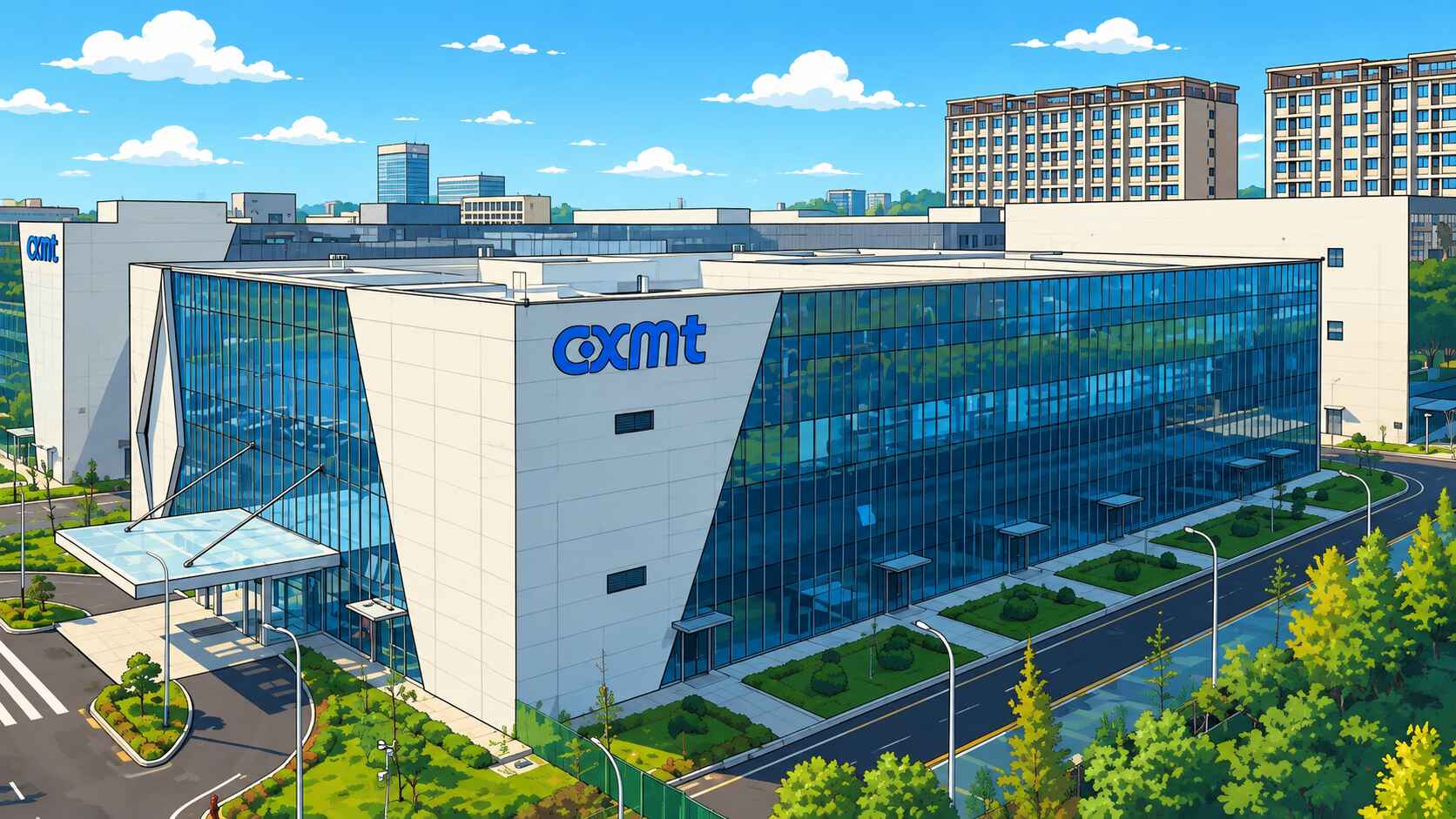
This article was updated on August 18, 2026, to include CXMT’s latest DDR5 performance, manufacturing yield, server-memory expansion, market share, and IPO.
When you buy a Corsair, Kingston, G.Skill, or TeamGroup memory kit, you probably assume the company printed on the heat spreader made the RAM.
That is only partly true.
Those brands usually design and assemble the finished modules, but the actual DRAM chips underneath often come from one of three companies:
- Samsung
- SK Hynix
- Micron
For years, these three manufacturers have controlled almost the entire global DRAM market. Different box. Different RGB pattern. Often the same tiny silicon underneath. Now, however, a fourth manufacturer is forcing its way into the club: CXMT, or ChangXin Memory Technologies.
And since this article was originally published in July 27th, CXMT has become considerably harder to describe as merely an emerging challenger.
Its DDR5 has crossed 9,000 MT/s in vendor testing. Manufacturers are experimenting with DDR5-6000 CL30 and even CL28 configurations using its chips. Reported DDR5 production yields have climbed above 90%. Major Chinese technology companies are buying its server memory.
Then CXMT went public in July 2026 and briefly became China’s most valuable listed company by market capitalization. Apparently, knocking politely was taking too long.
Also read: Unified Memory Explained: Why AI Is Changing How Computer Memory Works
Wait, RAM Brands Do Not Always Make RAM?
Before discussing CXMT, we need to separate two parts of the memory industry.
Companies such as Samsung, SK Hynix, Micron, and CXMT manufacture the actual DRAM integrated circuits. These are the tiny chips responsible for storing data.
Meanwhile, brands such as Corsair, G.Skill, Kingston, Patriot, Lexar, Asgard, and TeamGroup purchase those chips, install them on memory modules, test them, assign speed ratings, add heatsinks, and sell the finished products.
In other words: CXMT makes the ingredients. Corsair prepares the meal. RGB provides the garnish nobody requested but everyone secretly enjoys.
This means two visually identical memory kits can contain chips from different manufacturers. It also means you could buy CXMT memory without seeing the CXMT name prominently displayed anywhere on the box.
That is already happening. CXMT chips have appeared in memory products from established module brands, while motherboard manufacturers are increasingly validating their platforms specifically for CXMT-based DDR5.
Who Is CXMT?
CXMT was founded in 2016 as part of China’s broader effort to build a domestic DRAM industry.
That matters because memory is one of the foundations of modern computing. CPUs, GPUs, smartphones, servers, and AI accelerators are all rather useless if they cannot store and retrieve data quickly.
A processor without memory is basically a genius who forgets the question before answering it.
China has historically depended heavily on foreign DRAM suppliers. CXMT was created partly to reduce that dependence while building a domestic competitor to Samsung, SK Hynix, and Micron.
Its earliest commercial products focused on DDR4 and low-power mobile memory. It later expanded into DDR5, LPDDR5X, and server memory.
The company still does not lead the industry technologically. Samsung, SK Hynix, and Micron possess decades of manufacturing experience, access to more advanced fabrication equipment, and much stronger positions in areas such as High Bandwidth Memory.
But CXMT no longer resembles an experimental domestic alternative. It is now the world’s fourth-largest DRAM producer.
Its IPO prospectus put CXMT’s share of global DRAM revenue at 7.67% in 2025, while other estimates based on production or bit shipments put its share closer to 9–10% around 2025 and early 2026. The different figures measure the market differently, but the broader conclusion is the same:
The DRAM Big Three finally have a fourth company large enough to matter.
Could be related: Lisuan Explained: Why Building a GPU Takes More Than Money
Why Making DRAM Is So Difficult
DRAM sounds simple in theory. It stores bits using microscopic electrical charges.
In practice, a modern DRAM chip contains billions of tiny memory cells. Each must hold data reliably, refresh correctly, operate at high speed, and consume as little power as possible.
Then the manufacturer must produce millions of nearly identical chips at a competitive price.
Making one working chip is impressive. Making an entire wafer of working chips is a business. The percentage of usable chips produced from a wafer is called yield, and historically this has been one of the biggest advantages enjoyed by Samsung, SK Hynix, and Micron.
A manufacturer may successfully create a fast DDR5 chip but still struggle commercially if too many chips fail testing or cannot reach their intended specifications. It is like baking 100 cookies and discovering that only 45 are legally recognizable as food.
The recipe technically works. The business model may need therapy.
CXMT May Be Solving the Yield Problem
This is why one of the most important recent CXMT developments has almost nothing to do with spectacular overclocking numbers.
Recent industry reports claim that CXMT has achieved above 90% production yield on its 17 nm-class DDR5 process. The same reports put Samsung’s yield for comparable DDR5 production at roughly 92–93%.
Those numbers should be treated cautiously because semiconductor manufacturers rarely publish perfectly comparable yield data, and process-node labels themselves are not directly equivalent between companies.
Still, if the reported figures broadly reflect mass production, they suggest that CXMT has made substantial progress on exactly the problem that matters most.
A prototype can be fast. A successful memory company needs millions of chips to be functional, consistent, and economical enough to sell. Making one good cookie was never the end goal.
Apparently, CXMT has figured out how to stop burning most of the bakery.
Check out my other article: PC vs Smartphone: The Business of Obsolescence
Myth One: CXMT Will Make RAM Much Cheaper
The easiest assumption about CXMT is that Chinese manufacturing will automatically create bargain-priced RAM. More manufacturers mean more supply. More supply means lower prices. Economics has once again arrived to ruin a perfectly reasonable theory.
Earlier comparisons in China showed CXMT-based DDR5 modules selling at prices broadly comparable to products using Samsung or SK Hynix chips rather than dramatically undercutting them.
That makes sense.
Products are not priced exclusively according to how much they cost to manufacture. They are priced according to supply, demand, and what customers are willing to pay.
And CXMT has entered the market during an unusually strong memory cycle driven partly by servers and AI infrastructure.
When manufacturers can already sell huge quantities of what they produce, there is little incentive to begin an unnecessary price war. You do not open the only umbrella shop during a thunderstorm and immediately announce a clearance sale.
CXMT may still pressure memory prices over the long term by increasing global capacity. But its immediate importance is not that it will magically make your next 64GB kit cost half as much.
It is that there is another meaningful supplier.
Myth Two: CXMT Memory Is Automatically Slow
This argument has become increasingly difficult to make.
When CXMT first entered DDR5, simply reaching competitive mainstream speeds was noteworthy.
Then came 8,000 MT/s. CXMT-based memory was subsequently demonstrated at 8,200 MT/s, 8,600 MT/s, and 8,800 MT/s across AMD and Intel systems.
Now it has crossed another symbolic barrier.
A 48GB Colorful iGame Shadow II kit using CXMT chips has been demonstrated above 9,000 MT/s on AMD’s AM5 platform, using Colorful’s iGame X870E VULCAN W OC motherboard. The reported memory clock was approximately 4,507 MHz, translating to just over 9,000 MT/s because DDR transfers data twice per clock cycle.
That is impressive. But the more interesting development may be happening at much lower frequencies. Colorful has also been testing CXMT-based memory around DDR5-6000 CL30, with preliminary testing reportedly reaching CL28.
And that matters because frequency was never the entire question.
Performance Is More Than One Large Number
Memory marketing loves transfer rates because large numbers look excellent on boxes. DDR5-9000 sounds obviously superior to DDR5-6000. It has 3,000 more DDR5s.
Reality is slightly less cooperative.
Memory performance depends on:
- Transfer rate
- Primary and secondary timings
- Latency
- Memory-controller behavior
- Module capacity
- Rank configuration
- CPU architecture
- Motherboard layout
- Voltage
- Workload
A 9,000 MT/s demonstration proves that CXMT dies can reach extremely high frequencies under the right conditions.
It does not prove that every retail CXMT module will reach 9,000 MT/s, that CXMT has matched the best SK Hynix dies in every characteristic, or that these demonstrations represent long-term stability across thousands of systems.
Vendor demonstrations are also not the same as independent testing of hundreds of retail kits. But DDR5-6000 CL30 and CL28 are interesting for a different reason.
Those configurations move CXMT closer to the sort of frequency-and-latency combinations enthusiasts actually use rather than merely producing a heroic screenshot for the internet.
CXMT is no longer proving only that its memory can clock high. It is beginning to demonstrate competitive characteristics at more sensible enthusiast speeds.
Motherboard Vendors Are Optimizing for CXMT
One of the clearest signs of CXMT’s maturation is not a benchmark record. It is motherboard firmware.
Memory compatibility depends on far more than the DRAM chips themselves. During startup, the motherboard must train the memory controller by testing timings, voltages, signal behavior, and numerous other parameters.
Historically, BIOS development naturally concentrated on Samsung, SK Hynix, and Micron because those were the chips almost everyone used. That is changing.
Companies including ASUS, Gigabyte, MSI, and Colorful have increasingly demonstrated, validated, or optimized systems around CXMT-based memory.
Firmware engineering is not free. Motherboard companies do not spend engineering resources optimizing around a memory manufacturer they expect to disappear next Tuesday.
The ecosystem itself is starting to treat CXMT as normal. That may be more important than any single overclocking record.
Also read: Loongson Explained: Can China Build a CPU Without Intel, AMD, or Arm?
CXMT Is Moving Into the Server Room
Desktop DDR5 gets attention from PC enthusiasts, but servers are becoming increasingly important to CXMT’s business.
In June 2026, Reuters reported that Tencent signed a multi-year server DRAM supply agreement with CXMT worth around $3 billion. CXMT has also reportedly signed a five-year server-memory deal worth more than $7 billion with ByteDance.
According to figures reported from CXMT’s IPO materials, server products accounted for around 26.5% of revenue in 2025, compared with just 8.4% in 2024. This matters because AI infrastructure does not consume only GPUs and exotic HBM. Servers also require enormous amounts of conventional DRAM.
That gives CXMT a way to benefit from the AI infrastructure boom even before it becomes a leading HBM producer.
In an amusing twist, Tencent’s enormous AI infrastructure spending is therefore helping create demand for memory supplied by the company that briefly overtook Tencent in market capitalization.
Tencent spends money on AI. Some of that money goes to CXMT. Investors worry about Tencent spending so much money. CXMT becomes worth more than Tencent.
Capitalism occasionally writes jokes better than I do.
Then CXMT Became a $500 Billion Company
On July 27, 2026, CXMT went public on Shanghai’s STAR Market after raising approximately 57.92 billion yuan, or $8.6 billion, in what was Asia’s largest IPO of the year at the time.
Its shares then went slightly berserk.
CXMT closed its first trading day 466% above its IPO price, producing a market capitalization of roughly $487 billion. Within weeks, its valuation climbed beyond $500 billion and briefly surpassed Tencent’s, making CXMT China’s most valuable listed company by market capitalization.
This does not mean CXMT suddenly became operationally larger or technologically superior to Tencent, Micron, SK Hynix, or Samsung.
Market capitalization measures what investors are willing to pay for a company’s equity. It reflects expectations about future growth as much as the size of the existing business.
CXMT’s enormous post-IPO valuation also deserves additional context because only a limited portion of its total shares entered public trading.
Stock markets, furthermore, have been known to become enthusiastic. Occasionally very enthusiastic. Nevertheless, the valuation reveals how dramatically expectations surrounding CXMT have changed.
Investors are no longer valuing it merely as China’s attempt to create domestic DRAM. They are betting on CXMT becoming one of the major suppliers behind China’s growing computing and AI infrastructure.
What About AI and HBM?
There is one giant caveat. High Bandwidth Memory remains a much more difficult battlefield. HBM stacks multiple memory dies vertically and connects them using extremely dense pathways, delivering the huge bandwidth required by modern AI accelerators.
Producing competitive HBM involves more than manufacturing conventional DRAM. It requires sophisticated packaging, stacking, thermal management, testing, and close cooperation with accelerator designers.
SK Hynix remains particularly strong in this market, while Samsung and Micron continue investing heavily. CXMT has ambitions in advanced memory, but it still faces significant disadvantages in manufacturing technology and access to cutting-edge equipment.
Most importantly, U.S.-led export restrictions prevent Chinese semiconductor manufacturers from freely accessing some of the advanced lithography equipment available to their international competitors, including EUV systems.
Crossing 9,000 MT/s with desktop DDR5 is impressive. Building world-class HBM at enormous scale is another dungeon entirely, and the enemies have considerably larger health bars.
Can CXMT Really Take 30% of the DRAM Market?
CXMT apparently does not intend to remain a distant fourth forever.
Recent reports suggest that the company ultimately wants to capture around 30% of the global DRAM market by 2030, supported by aggressive capacity expansion including plans for another mega-fab.
That target should be treated as an ambition, not a prediction.
Reaching 30% would require enormous manufacturing expansion, continued improvement in yields, competitive next-generation products, and the ability to overcome restrictions on advanced semiconductor equipment.
The existing manufacturers are also unlikely to spend the next four years politely observing. Samsung, SK Hynix, and Micron continue investing billions of dollars into newer DRAM processes, HBM, packaging, and manufacturing capacity.
But the target reveals something important about CXMT’s strategy. China is no longer trying merely to create enough domestic DRAM to reduce dependence on foreign suppliers. CXMT wants to turn the Big Three into a Big Four.
Will CXMT Change RAM Prices?
Probably. Just not necessarily tomorrow.
Additional CXMT capacity can absorb part of China’s enormous domestic memory demand. That potentially leaves more Samsung, SK Hynix, and Micron capacity available elsewhere.
CXMT also gives PC manufacturers, laptop companies, server builders, and memory-module vendors another supplier to negotiate with. That changes bargaining power. Over time, additional capacity could produce stronger price competition, particularly during periods when memory supply exceeds demand.
But CXMT has very little reason to sacrifice profits simply because PC enthusiasts would enjoy cheaper upgrades. Like every other semiconductor company, it has apparently discovered the revolutionary economic principle known as charging what people will pay.
Should You Avoid CXMT Memory?
Not automatically. Most consumers already purchase memory based on the finished module rather than the microscopic logo printed on every DRAM chip.
If a Corsair, Lexar, Colorful, Asgard, or other branded kit uses CXMT chips, runs at its advertised settings, passes compatibility testing, and comes with a proper warranty, the chip manufacturer may matter surprisingly little to the average buyer.
Enthusiasts who chase extreme timings and overclocking records will continue caring about specific memory dies. Different dies have different voltage behavior, timing potential, temperature sensitivity, and consistency.
But for normal buyers, the sensible questions remain:
- Does it run at the advertised speed?
- Is it stable?
- Is it compatible with your motherboard?
- Is the price reasonable?
- Does it have a warranty longer than the average live-service game?
The manufacturer of the DRAM IC is only one part of the answer.
CXMT Does Not Just Want a Seat Anymore
When CXMT first emerged, the question was whether China could create a serious domestic DRAM manufacturer at all. Then the question became whether CXMT could produce competitive DDR5. Then whether motherboard companies would support it. Then whether it could manufacture those chips efficiently enough to matter.
Those questions are not completely settled, but the evidence has changed dramatically.
CXMT-based DDR5 has now crossed 9,000 MT/s in vendor demonstrations. Manufacturers are experimenting with CL30 and even CL28 timings. Reported DDR5 yields are above 90%. Its memory is appearing across consumer platforms. Major Chinese technology companies are signing billion-dollar server-memory agreements with it.
And CXMT now owns a measurable chunk of the global DRAM market rather than existing somewhere in the semiconductor industry’s rounding error.
None of this means Samsung, SK Hynix, or Micron should begin packing their desks.
CXMT still trails its established rivals in important areas. Advanced fabrication technology remains a challenge. HBM is a different level of difficulty entirely. Export restrictions complicate access to leading manufacturing equipment. And decades of production experience cannot simply be purchased with a very enthusiastic IPO.
But CXMT’s ambition is no longer merely to prove that it deserves a seat at the table. That part increasingly looks settled. It wants to make the Big Three a Big Four. And suddenly, that does not sound ridiculous.
