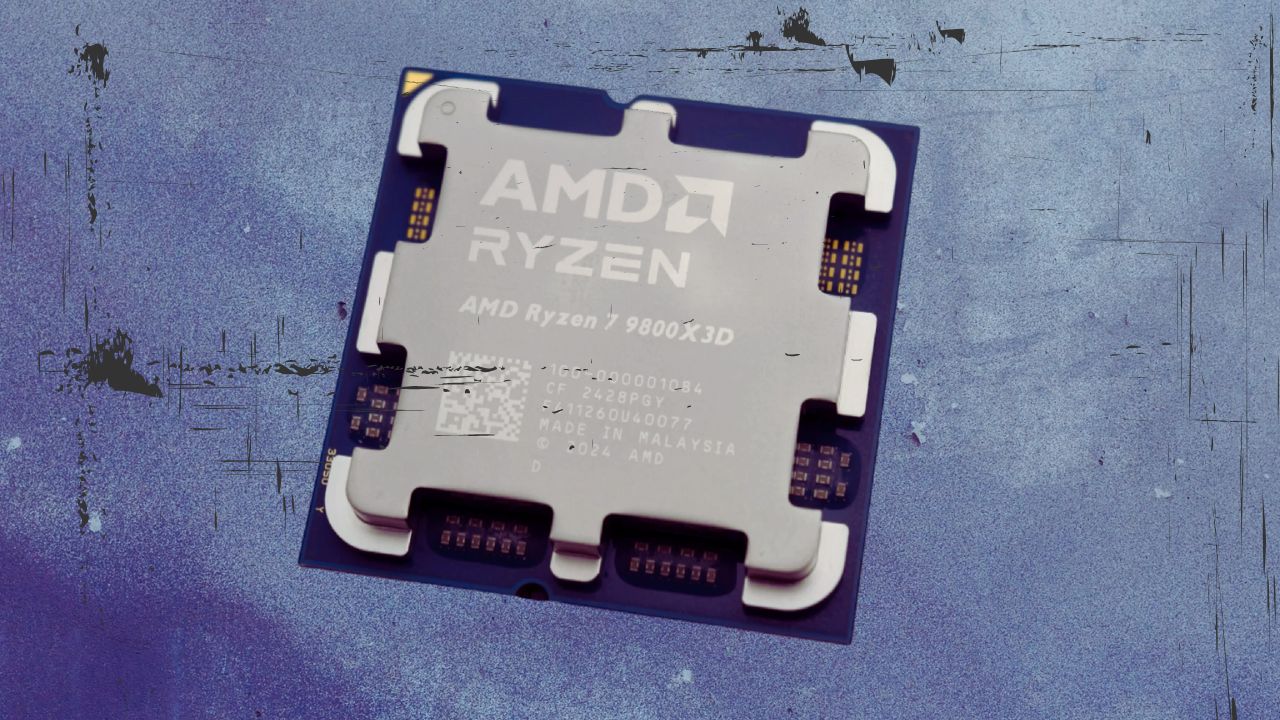
AMD’s X3D chips have spent the last few years building a reputation as the go-to CPUs for gaming. More cache, more frames, happy PC nerds. Simple enough. But now there’s a new twist: that same extra cache may also make Ryzen X3D processors surprisingly effective for certain AI workloads.
And not the flashy “look, my GPU made a dragon in 0.8 seconds” kind of AI. This is the less glamorous, but increasingly important, plumbing behind retrieval-augmented generation, or RAG. In a new benchmark run, AMD’s 3D V-Cache parts reportedly delivered gains of up to 88% over their non-X3D counterparts in vector-search-heavy tests. That is not a rounding error. That is a “maybe we should stop thinking of these chips as gaming-only parts” moment.
Why RAG cares about CPU cache in the first place
Most people hear “AI” and immediately think of GPUs. Fair enough. GPUs still do the heavy lifting for model inference because they are built for massively parallel workloads.
But RAG changes the shape of the problem.
Instead of relying only on what a large language model already knows, a RAG pipeline pulls relevant information from an external database and feeds it into the model at query time. That makes responses more grounded and more current, which is why RAG has become such a popular approach for local AI systems, enterprise assistants, and on-prem knowledge tools.
The catch is that retrieval has to happen somewhere, and a lot of that work still lands on the CPU.
That is especially true for vector database searches and graph-based retrieval methods like HNSW, short for Hierarchical Navigable Small World. These search methods benefit from fast access to large data structures. In other words, cache matters. A lot.
Checkout my other article: USB Explained: The Universal Standard That Isn’t
3D V-Cache looks tailor-made for search-heavy AI workloads
That is where AMD’s 3D V-Cache design starts to look very clever outside gaming.
The premise is straightforward: if retrieval workloads spend a lot of time bouncing through graph structures and memory-sensitive data, then a CPU with significantly more cache can reduce latency and keep more of that data closer to the cores.
GiggleHD’s open-source X3D RAG Benchmark was built to test exactly that. The benchmark is aimed at personal PCs and small-team, single-node RAG setups, roughly in the 100K to 200K vector range. So this is not pretending to model a hyperscale cloud service. It is much more about the kind of local or on-prem deployment enthusiasts, developers, and smaller organizations might actually run.
And in that context, AMD’s X3D chips appear to have a serious edge.
The performance numbers are hard to ignore
The standout result comes from the 100K Batch Search test, where Ryzen 3D V-Cache CPUs were reported to be up to 88% faster than equivalent non-X3D parts.
That is the kind of jump that makes hardware people sit up straight and stop pretending every CPU generation is just “a modest uplift.”
The gains continued elsewhere:
- In the 200K Batch Search test, the Ryzen 7 9850X3D delivered more than a 50% improvement over the Ryzen 7 9700X
- In Index Build tests, times were reduced by 50% in the 100K run and 39% in the 200K run
- Throughput also improved on the 3D V-Cache chips
- In Concurrent RAG Throughput tests, the 8-core X3D CPUs continued to perform strongly
One of the more interesting details is that the 8-core X3D chip even outpaced the 16-core Ryzen 9 9950X in some scenarios. That tells you something important about this workload: brute-force core count is not always the answer. Sometimes the memory hierarchy is the real boss.
Not every AI task gets the same benefit
Before anyone starts calling the X3D lineup the ultimate AI CPU family, there is an important caveat.
In TTFT throughput tests, the gaps between processors were much smaller. That is because this part of the pipeline leans more heavily on the GPU than the CPU. So while extra cache helps a lot in retrieval and indexing, it does not magically accelerate everything in the AI stack.
That nuance matters.
What these results really show is that AI performance is becoming increasingly workload-specific. There is no single “best AI processor” in a vacuum. There is only the best processor for the part of the pipeline you care about most.
For LLM inference, the GPU still dominates the conversation. For search-heavy RAG pipelines, especially local ones, the CPU suddenly becomes much more interesting.
Why this matters beyond benchmark bragging rights
The bigger industry takeaway is not just that AMD found another use case for 3D V-Cache. It is that AI infrastructure is getting more balanced.
As agentic AI systems grow more complex, they are likely to rely on more retrieval, more memory lookups, and more orchestration between components. That means CPUs are not just there to keep the chair warm while the GPU does all the exciting work. They are becoming a bigger part of the latency story.
That shift could make cache-rich CPUs far more relevant in AI buying decisions than they were even a year ago.
For AMD, that is a pretty nice development. The company already had a strong enthusiast pitch with X3D: buy this if you want top-tier gaming performance. Now it may be able to add another line to the sales deck: also great for local RAG workloads, because apparently massive cache is the gift that keeps on giving.
Intel, meanwhile, may want to look at this trend and quietly clear its throat.
The real sweet spot: local and on-prem RAG
The benchmark’s scope is worth emphasizing. This is aimed at local and small-scale RAG deployments with around 100K to 200K vectors, not giant distributed enterprise databases.
That actually makes the findings more practical for a lot of users.
If you are building a personal knowledge assistant, an internal search tool, or a single-node on-prem AI system, these are exactly the kinds of workloads that matter. And in that space, an 8-core X3D chip starts to look less like a luxury gaming toy and more like a genuinely smart systems choice.
That is a fun role reversal. For years, people justified gaming CPUs by saying, “well, it’s good for other things too.” Now AMD may be able to justify an AI-friendly CPU by saying, “and yes, it also crushes games.”
Final thought
AMD’s 3D V-Cache chips were designed to win over gamers, but these RAG benchmark results suggest they may have stumbled into a second act as highly capable AI retrieval processors.
The headline number, up to 88% faster than non-X3D parts in batch search, is impressive on its own. But the more important lesson is broader: as AI workloads become more retrieval-driven, cache and CPU behavior will matter more than many people expected.
Turns out stuffing extra cache onto a CPU was not just about squeezing out a few more frames in Cyberpunk. Sometimes it also helps your AI find the right answer before your users lose patience.